India's High Commissioner on Indian Workers and Students in Cyprus: What He Said and What It Means for You
By Manav Majumdar · 18 October 2026
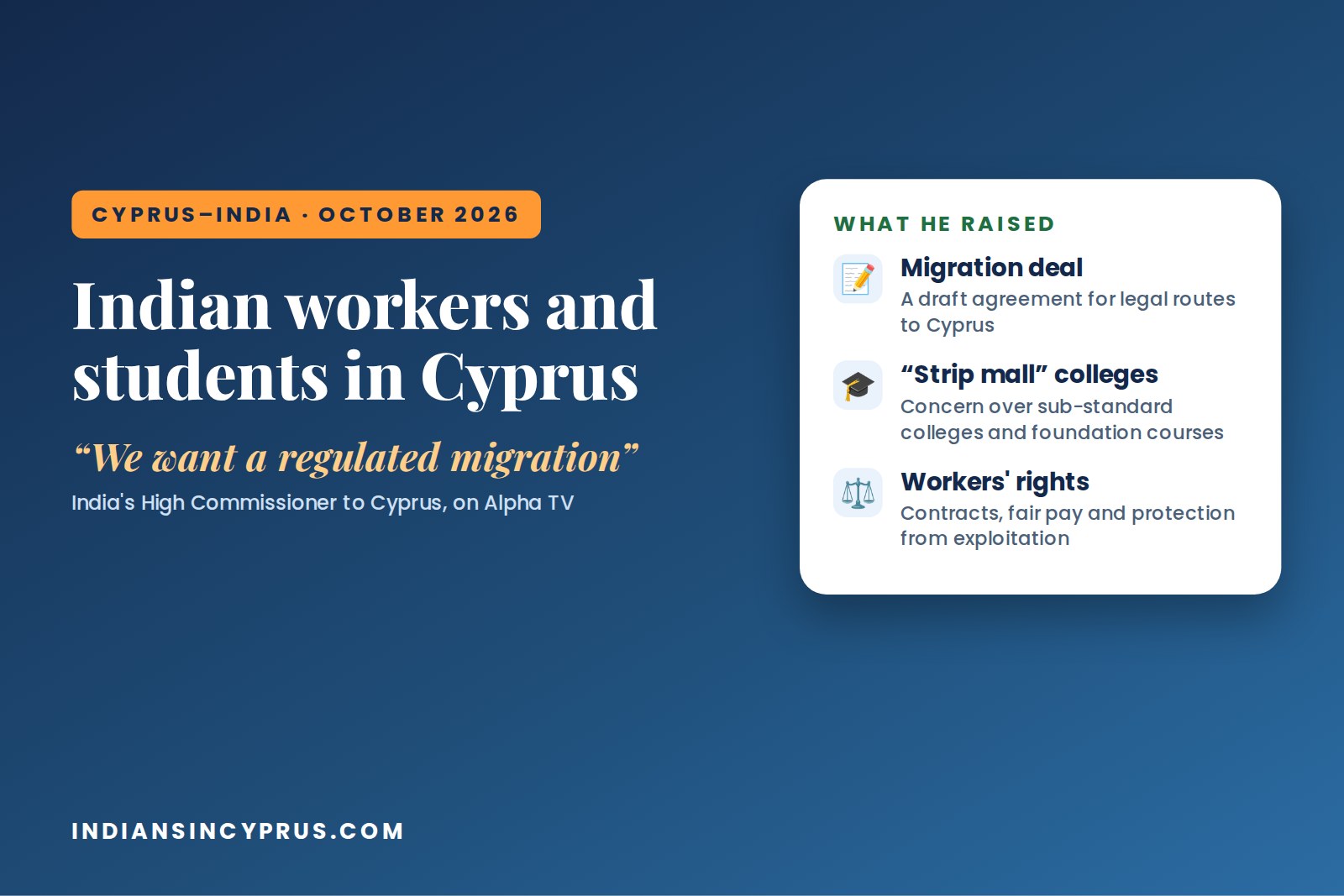
When India's High Commissioner to Cyprus, Shri Manish, sat down with Alpha TV's Sunday programme on 18 October, the conversation began with investment and defence. It ended somewhere much closer to home for many of us: how Indian workers and students are treated on the island, and what needs to change.
Here is what he said, in our own words, and what it means if you are living, working or studying in Cyprus, or planning to.
“We want a regulated migration”
The High Commissioner was clear that the Indian people seen in Cyprus did not slip in through the back door. They arrived with valid visas and work or student permits issued by Cypriot ministries and departments. What is missing, in his view, is a formal framework that makes migration between the two countries legal, predictable and safe.
His priority, he said, is simple: the lives and rights of Indians who come here to live, work and study must be protected. In his words, “we want a regulated migration.”
Talks on a migration deal
India is negotiating a migration and mobility agreement with Cyprus's Deputy Ministry of Migration and International Protection. According to the High Commissioner, a draft already exists. It would set out legal routes for students, skilled workers and staff moving within the same company. Talks could not be wrapped up before President Christodoulides' state visit to India in May, so India is now expecting the final version of the text.
Work on such a deal started years ago: when India's External Affairs Minister visited Cyprus in December 2022, both sides signed a declaration of intent on it.
He also stressed why it matters now: the number of Indians in Cyprus has roughly doubled, and he put today's figure at about 18,000. India's foreign ministry, in a brief dated May 2026, gave a lower figure of about 15,500 for April 2026, which suggests numbers are still rising.
The trouble with “strip mall” colleges
The sharpest part of the interview was about education. Some private colleges, the High Commissioner said, see Indian students as big business and are racing each other to sign them up. A number of them fall short of proper standards, and he described one-room colleges operating out of shopping centres, known in some countries as “strip mall” colleges.
He estimated that there are more than 5,000 Indian students in Cyprus, and was careful to say he was not talking about the big universities. His concern is that for some colleges, the student visa has become a back route into the labour market. Many of these students end up working without contracts, paid in cash and earning far less than Cypriot or EU workers.
He singled out the Ministry of Education's one-year foundation course. Because so many students join it, not all of them go on to a full degree. When their student permits run out, they can be left without legal status, at the mercy of agents who exploit them, and eventually face deportation. He said he has already seen some incidents and tensions between communities, made worse at times by misunderstandings on social media, and that this puts pressure on everyone, from the authorities to hospitals.
He described himself as someone who serves India's interests but also as a friend of Cyprus, and called for a formal legal framework and better regulation of these one-year programmes.
Beyond workers: money and defence ties
Cyprus has long been one of the biggest sources of investment into India. India's industry ministry lists the island among its nine biggest foreign investors: about US$15.8 billion arrived from Cyprus between April 2000 and June 2025. The High Commissioner pointed out that Cyprus's real strengths lie in services such as shipping, connectivity, accountancy and technology, so trade and services links are likely to come first.
On defence, he described the yearly cooperation programme between the two defence ministries, which covers training, exchange visits and observing each other's exercises. He added that some Indian and Cypriot companies are already working together on software, cybersecurity and drone components. He also recalled the visit of the Indian Navy frigate INS Trikand to Limassol in September 2025 and said he hopes more ships will follow.
What this means for you
- Choosing a college? Before you pay anything, check yourself that both the college and your exact course are accredited by the Cyprus Agency of Quality Assurance and Accreditation in Higher Education (CYQAA). An agent's word is not enough.
- Know what a foundation course is. It is a preparatory year, not a degree. Ask the college in writing what you need to move on to a degree, and what happens to your permit if you don't.
- Already a student? Follow the work rules. Students may only work outside study hours, in permitted sectors, and up to 20 hours a week in term or 38 hours when classes are not running. Keep your permit valid and renew it on time.
- Working? Get it in writing. A proper job for a non-EU worker comes with a contract approved by the Department of Labour. Avoid cash-only work, and keep your payslips and contract safe.
- If you are being exploited, speak up. Employment disputes can go to the district office of the Department of Labour Relations. Fraud, threats or other crimes must be reported to the police. The High Commission also accepts employment-related grievances and tries to settle them through negotiation (see its grievance guidelines), and students can register on the government's MADAD portal.
- Keep the High Commission's number handy. The High Commission of India in Nicosia can be reached on +357 22 351741 or +357 22 351170, as listed in the Government of India directory.
The interview has also sparked debate in Cyprus. In an opinion piece for Simerini, columnist Chris Michael argued that protecting workers' rights should be part of any closer partnership between the two countries.
Read also: Studying in Cyprus? What Indian Students Must Check Before Choosing a University, Indians Are 1 in 5 Non-EU Workers in Cyprus: Who Can Legally Work Here? and Stronger at Sea: What the Indian Defence Secretary's Cyprus Visit Means for Us
Sources: Alpha TV interview (YouTube, 18 October 2026), Alphanews (in Greek), WION, Ministry of External Affairs, India–Cyprus brief (May 2026), Simerini, opinion (in Greek), CYQAA, Cyprus Mail (student work rules), High Commission of India, Nicosia, Government of India directory
Related stories


Spotted an error? Tell us.