Working on a Building Site in Cyprus? Pay Rates, Raids and the Labour Shortage Explained
By Jayesh Shah · 3 November 2026
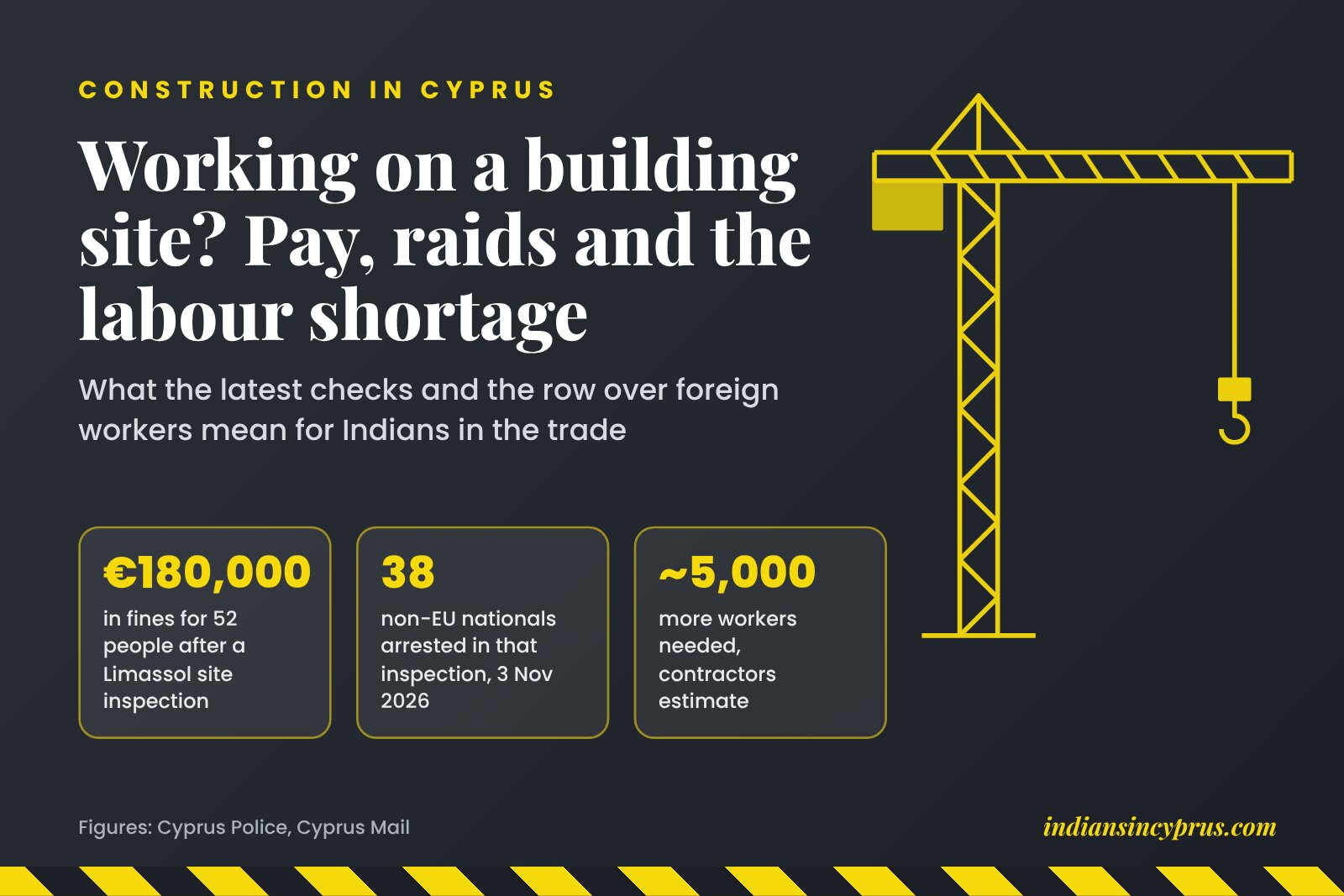
Cranes are up all over Cyprus, but the people to work under them are getting harder to find. Within a few days, Limassol saw a large inspection of a building site, the labour ministry and employers traded blame over foreign recruitment, and the construction unions threatened industrial action.
Plenty of Indians earn their living in Cypriot construction, as labourers, steel fixers, drivers and site supervisors. Here is a plain summary of what is going on, checked against official sources, and what it means if you, a friend or a family member works on a site.
The Limassol raid
Police and inspectors from the Labour Ministry's Inspection Service spent three hours on Tuesday morning, 3 November, checking an unfinished building complex in Limassol. According to the police announcement:
- 31 people were arrested for working on the site illegally. Eight of them were also staying in Cyprus without permission.
- Seven more people were arrested in the surrounding area for staying in Cyprus illegally. All 38 people arrested were from outside the EU.
- Their bosses: police are looking into the nine people who gave those 31 the work.
- €180,000 in fines was issued to 52 people for breaking the rules on undeclared work: the 31 workers, their nine employers and 12 other European nationals.
Police did not give the nationalities of those arrested, so nobody should assume who they were.
Why the sector is short of hands
Building contractors say they need roughly 5,000 extra workers just to replace people who have left, and that the gaps run across almost every trade, from steel fixers to stonemasons. Several things have happened at once:
- Thousands of Syrian workers have gone home under the repatriation programme; a Cyprus Mail editorial puts the loss at about 8,000.
- Some workers from other EU countries have found better opportunities back home.
- Turkish Cypriot builders, according to one contractor, now prefer jobs closer to home in the north, because fuel for the daily crossing has become expensive and a building boom there pays more per day.
Employers say hiring a construction worker from outside the EU can take up to eight months, and their federation, OEV, wants the process modernised and moved online. Meanwhile, according to the labour minister, a recruitment scheme with Egypt agreed last spring has not brought in a single worker. The labour ministry says that is because no construction firm has applied, and that checking an employer's terms takes six weeks at most.
Caps on foreign workers, and a union demand
The Labour Ministry's framework for employing foreign workers lets a business fill as much as 30 per cent of its workforce, averaged over the previous three months, with non-EU staff. A business that applies a sectoral or company collective agreement may go up to half. Construction is not one of the sectors given higher limits. Employers say even half is too little, while the unions oppose raising the caps, warning that more hiring from abroad would push wages down.
On 2 November the construction unions SEK, PEO and DEOK went further. They are angry that the ministry keeps renewing permits for building firms and subcontractors facing complaints of breaching labour law or collective agreements, and want those permits refused or reviewed, joint union and employer committees to vet applications, and tougher site inspections.
In an editorial on 4 November, the Cyprus Mail argued that no law forces an employer to sign up to a collective agreement. On building sites, though, the law goes further than in most jobs: under the Employees in the Construction Industry (Basic Terms of Service) Law of 2020, the basic terms of the sector agreement cover construction workers, and the Department of Labour Relations says a company with its own agreement must still respect them. The ministry's framework also expects anyone hiring non-EU staff to apply a collective agreement or offer equivalent terms.
What the industry's pay floor says
The sector agreement runs from June 2022 to the end of 2027 and is published by the Department of Labour Relations. It is based on a 38-hour, five-day week, with overtime counted after 38 hours. Its minimum weekly starting wages from 1 August 2024 were:
- €486.48: category A tradesmen (builders, steel fixers, formwork carpenters, plasterers, painters) and mechanics, machine operators and category A drivers.
- €412.49: general workers.
- €385.39: category B tradesmen and category B machine operators.
- €363.44: assistant formwork carpenters, steel fixers and painters.
These are not today's rates. The agreement adds a general rise of €7 a week from 1 January 2025 and another €7 from 1 January 2026, with a third due in January 2027, on top of the automatic cost-of-living adjustment. So pay in 2026 should be above the 2024 figures. The ministry also says these rules cover everyone doing construction work in the listed trades, whether they are paid weekly or monthly.
What this means for you
- Get it in writing: to hire or renew a non-EU worker, the employer submits a standard employment contract signed by both of you. Keep your own copy, and make sure the job you actually do matches it.
- Don't work off the books: for each undeclared worker, the employer is fined €1,000 for the month it is found, plus €500 a month for six months unless the employer proves the breach was shorter, so up to €4,000 per worker, and more for repeat offences. But as the Limassol raid shows, workers are fined and arrested too, and anyone living here without a valid permit can be removed from Cyprus.
- Check your pay: compare your weekly wage and hours with the rates above, remembering the €7 rises since 2024. If you are paid less, ask a union or the Department of Labour Relations for help.
- Housing from your employer? Under the ministry's framework, your employer can deduct up to 25 per cent of your pay if the accommodation meets the official standards, and only 10 per cent if it doesn't meet all of them but is still acceptable.
- On a student permit? Only work within what your permit allows. Authorities have said they are stepping up checks at private colleges and plan stricter rules for foreign students.
- Skilled in a trade? Steel fixers, masons and other tradespeople are in short supply, so a legal, properly declared job is well worth waiting for. Be wary of anyone who asks you for money to "fix" a job or a permit.
- Need help? Our worker's rights guide lists where to report problems with pay, passports or contracts.
Read also: Know Your Rights as a Worker in Cyprus: Your Passport, Your Pay and Where to Get Help and Indians Are 1 in 5 Non-EU Workers in Cyprus: Who Can Legally Work Here?
Sources: Department of Labour Relations (construction agreement), Department of Labour Relations (construction FAQs), Labour Ministry Inspection Service (fines), Labour Ministry framework for foreign workers, Cyprus Times (police announcement), Cyprus Mail (Limassol inspection), Cyprus Mail (unions), Cyprus Mail (construction labour), Cyprus Mail (editorial), Cyprus Mail (student permits)
Related stories

Spotted an error? Tell us.