Opening a Bank Account in Cyprus: Documents, Checks and Your Rights
By Jayesh Shah · 7 October 2026
Last updated: 7 October 2026.
Your salary, your rent, your phone bill and the money you send home all run through one thing: a local bank account. Yet for many newcomers it's one of the slowest boxes to tick. Banks in Cyprus are strict about checks on new customers, especially those from outside the EU, so it pays to arrive with the right papers and realistic expectations.
Which banks?
The two biggest retail banks are Bank of Cyprus and Eurobank, which absorbed Hellenic Bank in 2025, so former Hellenic Bank branches and accounts now carry the Eurobank name. Smaller banks also operate. Many employers have a preferred bank for salary payments, so ask HR before you choose; it can make the process smoother.
Money held in a licensed bank in Cyprus is protected up to €100,000 per person, per bank, under the EU deposit guarantee rules.
What to take with you
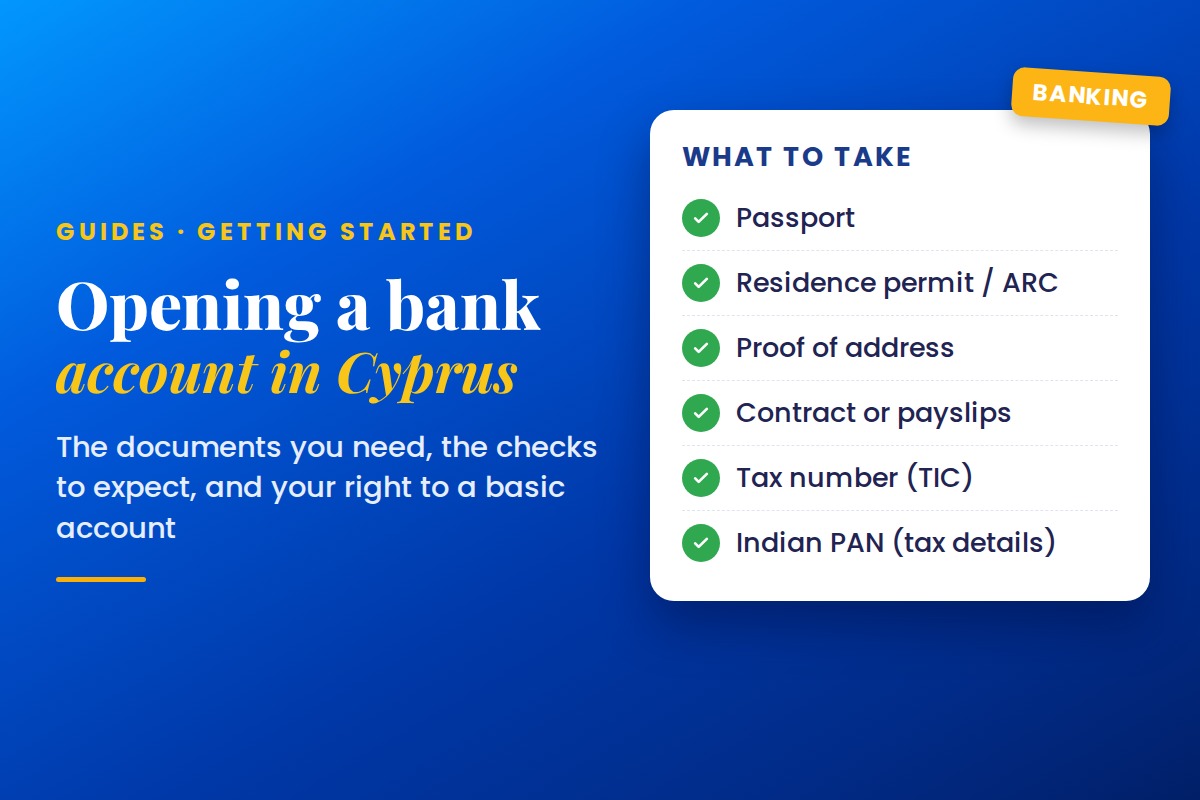
- Passport: the original, not just a copy.
- Residence permit or ARC: or the receipt showing your application is in progress. Some banks will wait until you have the permit itself.
- Proof of address in Cyprus: usually a recent utility bill (less than three months old) or a signed rental agreement. Some banks ask for two documents.
- Proof of income: your employment contract, a letter from your employer, or recent payslips.
- Cyprus tax number (TIC): often requested; see our moving checklist for how to get one.
- Your tax details: banks must report foreign customers' tax information under international rules (CRS and FATCA), so you'll fill in a self-certification form. If you're still tax-resident in India, you may be asked for your PAN.
What to expect
- An interview or video call: expect questions about your job, your salary and how you'll use the account, for example sending money to family in India. Answer plainly; these questions are routine.
- Time: allow a couple of weeks from first appointment to a working card, sometimes longer. Book your appointment early.
- Extra questions about money: if you'll deposit savings brought from India, keep the paperwork showing where they came from.
- Refusals happen: banks can decline applications. If that happens, read the next section.
Your right to a basic account
Under EU rules, applied in Cyprus by a 2017 law, anyone legally resident in the EU has the right to open a payment account with basic features. It lets you receive your salary, pay in and withdraw cash, use a debit card and make transfers. A bank that offers these accounts must give you a decision within 10 working days of a complete application, and the yearly charges are kept low. If a bank refuses you an ordinary account, ask specifically about the basic payment account, and if you think you've been treated unfairly, the Central Bank of Cyprus explains how to complain.
App-based alternatives
Many newcomers also use app-based accounts such as Revolut or Wise, which can be opened quickly and are handy for transfers. Check how your money is protected before keeping large sums there: Wise, for example, is an e-money institution, so balances are safeguarded but not covered by the deposit guarantee, while Revolut holds an EU banking licence. For salary and rent, most people still use a local bank.
What this means for you
- Get your paperwork in order first: permit or receipt, a rental agreement in your name and your TIC will solve most problems before they start.
- Ask your employer: a letter from HR and a preferred bank often speed things up.
- Don't take no for an answer straight away: you have a legal right to a basic payment account if you live here legally.
- Sending money home: compare your bank's exchange rate and fees with specialist services before regular transfers.
Read also: Sending Money Home? Bank of Cyprus Now Handles Payments in Indian Rupees and Moving to Cyprus from India? Your First 30 Days, Step by Step
Sources: Central Bank of Cyprus, Eurobank – basic payment accounts, Wikipedia – Hellenic Bank, Politis, Deposit Guarantee Scheme leaflet
Disclaimer: We make every effort to ensure the information in our guides is accurate and up to date, but rules, fees and procedures can change without notice. Please verify the details with the relevant official authority before acting on them. This guide is for general information only and is not legal, financial or immigration advice.
Related stories


Spotted an error? Tell us.