Taxed Twice? The India–Cyprus Tax Treaty in Plain Words
By Manav Majumdar · 12 October 2026
Last updated: 21 October 2026.
You work in Limassol, but the flat in Pune is still rented out. There's a fixed deposit in Chennai, a few shares bought years ago, perhaps a small pension on the way. Sooner or later the question comes up: will I pay tax on all this twice, once in India and once in Cyprus?
For most people, the answer is no, thanks to the tax treaty between the two countries. But the treaty only works for you if you understand the basics and keep the right paperwork. Here is a plain-language guide.
The treaty in one minute
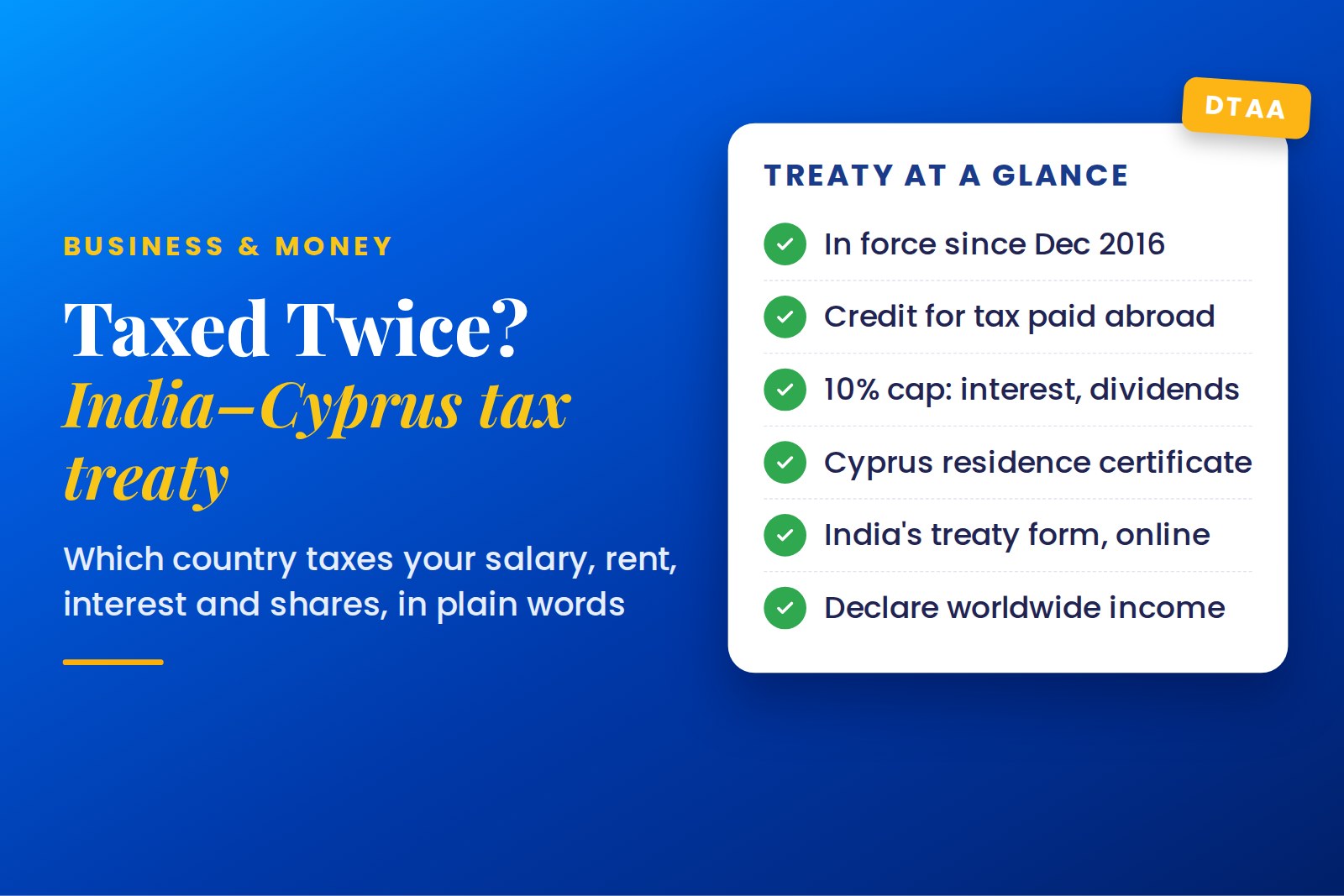
India and Cyprus signed their current Double Taxation Avoidance Agreement (DTAA) in Nicosia on 18 November 2016, and it took effect less than a month later, on 14 December 2016, in place of an older 1994 agreement. It has two jobs: deciding which country gets to tax each type of income, and making sure that when both can, you get credit in one country for tax paid in the other.
Since 2021, the treaty has also been updated by an international agreement known as the MLI, which adds anti-abuse rules. For ordinary families, the main thing to know is that the treaty still applies, and that artificial arrangements set up only to save tax won't qualify.
First question: where are you tax resident?
Everything starts here, because each country taxes its residents more heavily than outsiders.
- In Cyprus, you are generally tax resident if you spend more than 183 days here in a calendar year. A separate "60-day rule" can also make you resident with a shorter stay, if you meet several conditions such as working here, having a home here and not being tax resident anywhere else.
- In India, you usually count as resident once you spend 182 days there in its April-to-March financial year. Stricter tests apply to people with high Indian income, so check carefully if you spend long stretches at home.
- If both countries claim you, the treaty has tie-breaker rules that look at where your permanent home and closest personal and economic ties are.
Who taxes what: the common cases
- Your Cyprus salary. Pay for work done in Cyprus is taxed in Cyprus. India doesn't tax it if you are non-resident there.
- Rent from property in India. India can tax it, because the property is there. If you are tax resident in Cyprus, declare it here too and claim credit for the Indian tax.
- Interest and dividends from India. India can deduct tax at source, but the treaty generally caps it at 10%, provided you show the right documents (see below). Without them, banks often deduct much more.
- Selling Indian shares. For shares bought on or after 1 April 2017, India can tax the gain. Older holdings may still benefit from the earlier treaty's more generous rules.
- Crew and short assignments. Special rules cover seafarers and people working briefly in the other country. Shipping is big in Limassol, so if this is you, get advice that fits your contract.
The paperwork that makes it work
- A Cyprus tax residence certificate. Issued by the Cyprus Tax Department, it proves you are resident here. Indian banks and tax authorities ask for it before applying treaty rates.
- India's treaty declaration form. This is filed online on India's income-tax portal. It was long known as Form 10F; under India's new tax law it has been renumbered, so look for the current form when you file.
- Your PAN. Keep your Indian Permanent Account Number active and linked to your bank accounts.
- Proof of tax paid. Keep Indian tax deduction certificates and statements, because you'll need them to claim credit in Cyprus.
New laws, same treaty
Both countries have just rewritten their tax rules. India's Income-tax Act, 2025 has applied since 1 April 2026 in place of the 1961 law, and brings in a single "tax year". Cyprus brought in its own reform from 1 January 2026. Neither change cancels the treaty, but form names, section numbers and some rates have moved, so older online advice may be out of date.
What this means for you
- Work out your residence each year. Count your days in both countries, especially if you travel home for long visits.
- Don't accept 30% deductions without asking. If your Indian bank is deducting tax at a high rate on your interest, ask what it needs to apply the treaty rate.
- Declare Indian income in Cyprus. If you're resident here, your Cyprus return should show your worldwide income, with credit for tax already paid in India.
- Mind the deadlines. Cyprus returns for 2025 are now due by 30 November 2026 (extended from 31 October), and India has its own filing dates.
- Get help for anything complex. Property sales, inheritances, pensions and business income are worth a session with an adviser who knows both systems.
Deadline note: By law, employees' tax returns are due by 31 July of the following year, but in recent years the government has extended this every year, to different dates. For 2025 returns, it was moved first to 31 October and then to 30 November 2026. Always check the Tax Department's announcement for the current year before you file.
Read also: Your Cypriot Payslip and Tax, Explained: 2026 Rates and Deadlines
Sources: High Commission of India, Nicosia (Tax Corner), Income Tax Department of India (treaty text), Business Standard, Andersen Cyprus, Kuvera, Taxmann, Cyprus Mail – deadline extended, Sigmalive – deadline extended, PwC Tax Summaries – filing deadlines
Disclaimer: We make every effort to ensure the information in our guides is accurate and up to date, but rules, fees and procedures can change without notice. Please verify the details with the relevant official authority before acting on them. This guide is for general information only and is not legal, financial or immigration advice.
Related stories


Spotted an error? Tell us.