Your Cypriot Payslip and Tax, Explained: 2026 Rates and Deadlines
By Manav Majumdar · 7 October 2026
Last updated: 4 November 2026.
Your contract says one number; your bank account shows another. The gap is your deductions, and in Cyprus they're simpler than many people fear. This guide walks through a typical payslip, the new 2026 income tax rules, and the tax return deadline many employees don't know about.
What comes off your salary
For most employees, three things are taken from gross pay:
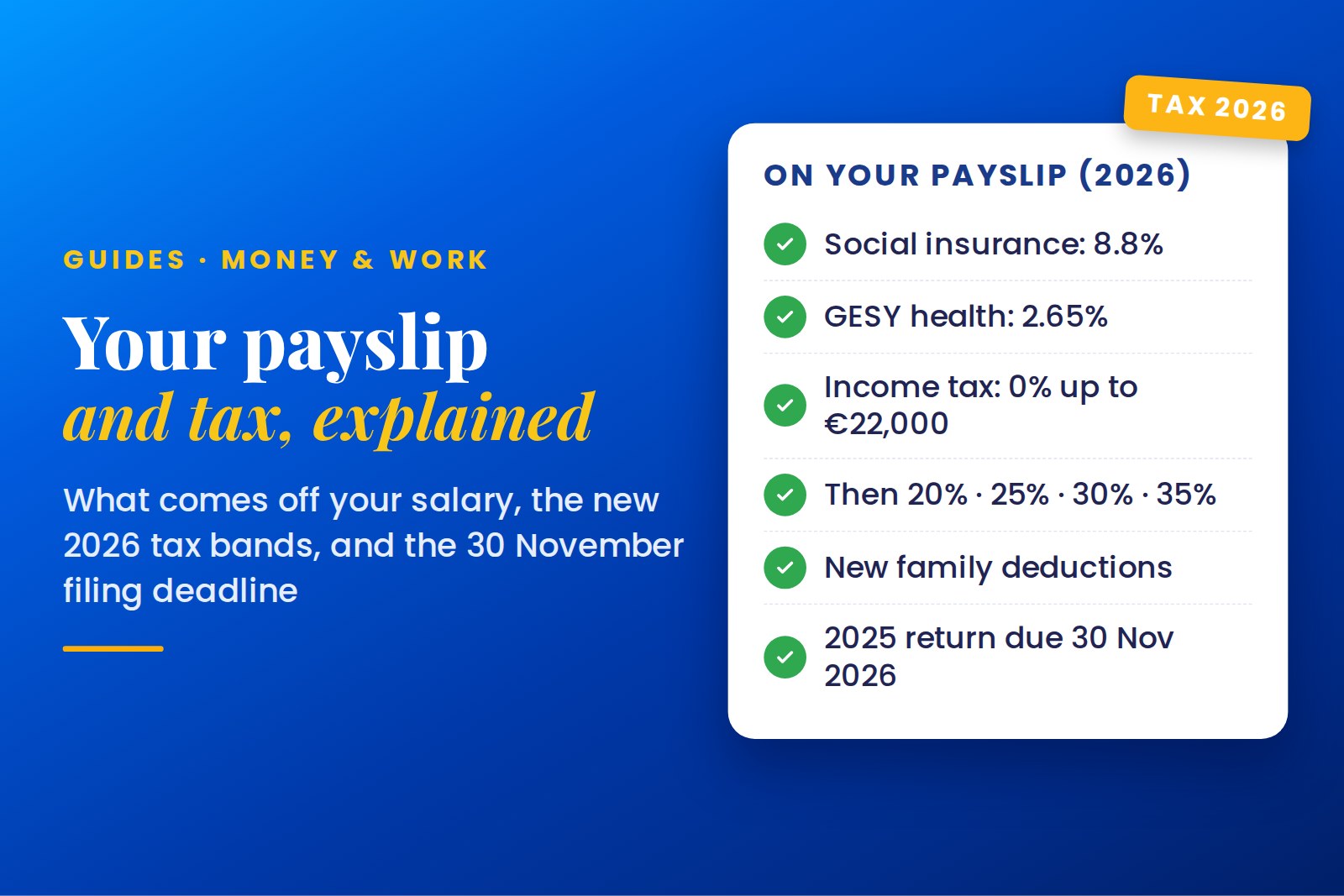
- Social insurance: 8.8%. This builds your entitlement to a Cypriot pension, unemployment and sickness benefits. Contributions stop at a yearly earnings ceiling, so very high earners pay less than 8.8% overall.
- GESY (national health system): 2.65%. This funds your access to GESY doctors, hospitals and medicines.
- Income tax (PAYE): only if your yearly income is above the tax-free amount (see below). Your employer deducts it monthly based on your expected annual salary.
Your employer also pays its own contributions on top of your salary (social insurance, GESY and several smaller funds). These don't come out of your pay, so you won't see them as deductions.
Some payslips also show a provident fund or union fees, if your workplace has them, and a 13th salary in December if your contract includes one.
A simple example
Say you earn €1,500 a month gross, or €18,000 a year:
- Social insurance (8.8%): €132.00
- GESY (2.65%): €39.75
- Income tax: €0, because €18,000 a year is below the €22,000 tax-free threshold
- Take-home pay: about €1,328.25 a month
Income tax from 2026
Cyprus overhauled its tax system from 1 January 2026. The tax-free amount rose from €19,500 to €22,000, and the bands now look like this:
- Up to €22,000: 0%
- €22,001 to €32,000: 20%
- €32,001 to €42,000: 25%
- €42,001 to €72,000: 30%
- Over €72,000: 35%
Each rate applies only to the slice of income inside its band. Someone with €30,000 of taxable income, for example, pays 20% only on the €8,000 above €22,000.
New deductions for families. From 2026 you can also claim deductions for dependent children (€1,000 for the first, €1,250 for the second and €1,500 for each further child), plus deductions for rent or mortgage interest on your home, green home upgrades and home insurance against natural disasters. Each has conditions and family income limits, so check the details before you claim.
The minimum wage
Since 1 January 2026, the national minimum wage for a full-time employee is €979 a month gross when you start, rising to €1,088 after six months with the same employer. Some sectors, such as hotels, domestic work and shipping, are covered by separate arrangements.
Filing your tax return
- The 2025 return is now due by 30 November 2026. The Tax Department has pushed the original 31 October deadline back by a month, and returns filed by 30 November carry no interest or penalties. If your gross income in 2025 was more than €19,500, you must submit a personal tax return (form TD1) online, even though your employer already deducted tax. Late filing carries a €150 penalty.
- Check before you press submit. With the move to the new TFA system, the Tax Department warns that from 1 November 2026 a 2025 return marked "Final Submission" may not be switchable back to "Temporary Receipt", so go through every figure before you finalise it.
- typeversionchildrendirectionformatindenttextFormat
- Where: for 2025, returns are still filed online through TAXISnet; the Tax Department's new Tax For All (TFA) portal takes over from the 2026 tax year. You'll need your tax number (TIC) and login details; your employer gives you a yearly statement of pay and deductions to help.
Deadline note: By law, employees' tax returns are due by 31 July of the following year, but in recent years the government has extended this every year, to different dates. For 2025 returns, it was moved first to 31 October and then to 30 November 2026. Always check the Tax Department's announcement for the current year before you file.
If you still have income in India
Cyprus taxes its tax residents on their worldwide income, and you're generally tax-resident if you spend more than 183 days in Cyprus in a year. India and Cyprus have a double taxation agreement, so the same income shouldn't be taxed twice, but you may still need to declare it. If you have rent, interest or other income in India, speak to a tax adviser who knows both systems.
What this means for you
- Check every payslip: make sure social insurance and GESY are deducted, so your benefits and healthcare are protected. Ask for a payslip each month if you don't get one.
- Mark 30 November in your diary: if you earned over €19,500 in 2025, file your return by then.
- Claim what you're due: parents and tenants may benefit from the new 2026 deductions.
- Keep records: payslips, your yearly employer statement, rent receipts and children's documents make filing easy.
Read also: Indians Are 1 in 5 Non-EU Workers in Cyprus: Who Can Legally Work Here? and Opening a Bank Account in Cyprus: Documents, Checks and Your Rights
Sources: Trident Trust – 2026 tax reform, Cyprus Mail – new deductions, Zeno Legal – social insurance and GESY 2026, Cyprus Mail – minimum wage, RSM Cyprus, RSM Cyprus – 2025 return and TFA, Sage Hill – TD1 deadline, Lexology – filing obligation, PwC Tax Summaries, Cyprus Mail – deadline extended, Sigmalive – deadline extended, Tax Department – individual tax return, Tax Department – tax reform FAQs (Greek)
Disclaimer: We make every effort to ensure the information in our guides is accurate and up to date, but rules, fees and procedures can change without notice. Please verify the details with the relevant official authority before acting on them. This guide is for general information only and is not legal, financial or immigration advice.
Related stories
Spotted an error? Tell us.