Prada, Dior and the 'Scandinavian Scarf': When the World Forgets to Credit Indian Craft
By Roshni Chopra · 27 October 2026
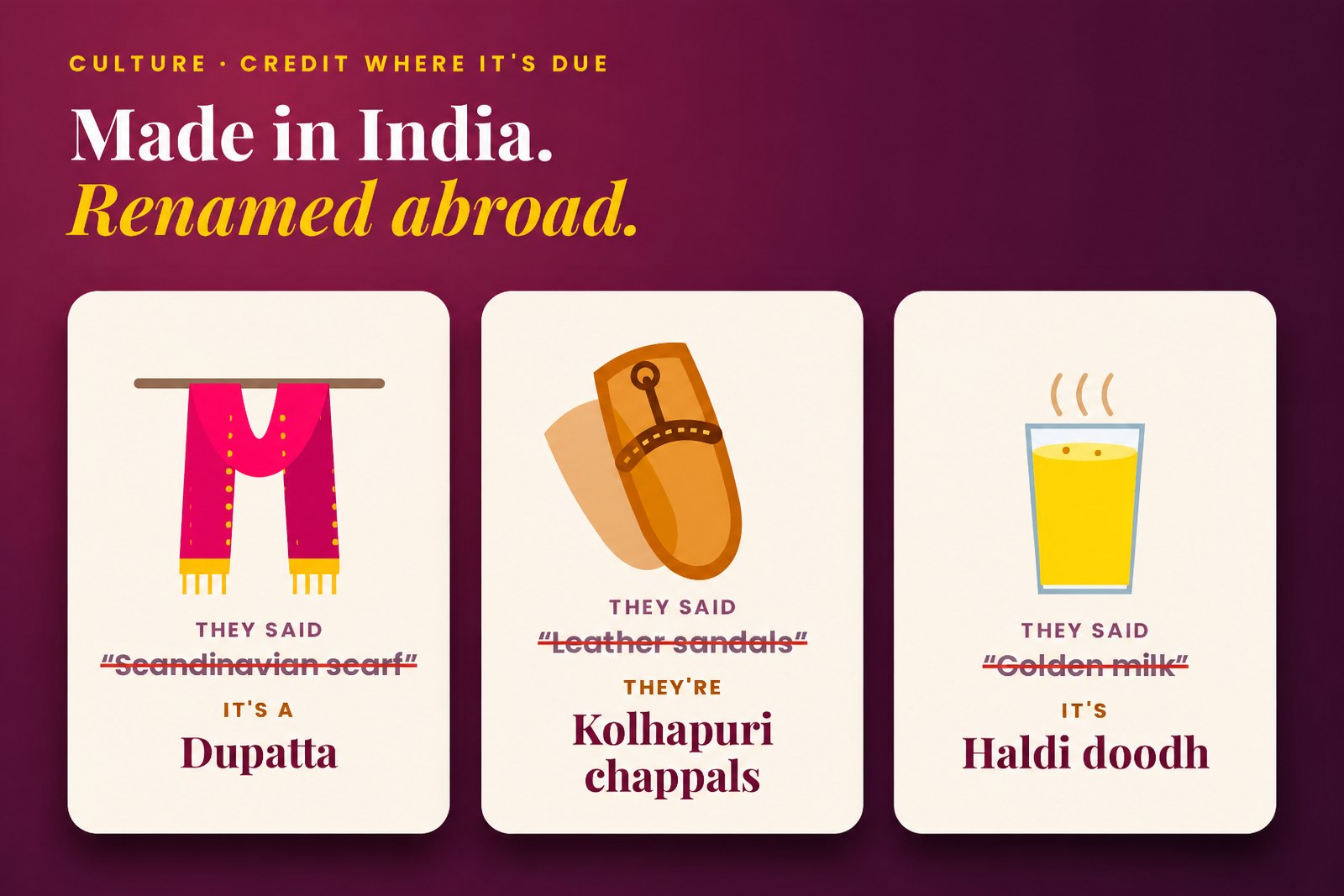
Food and fashion have always travelled. Every now and then, though, an Indian tradition crosses the world and loses its name on the way. A shawl that Indian women have draped for generations shows up online as a "Scandinavian scarf". A sandal made in the villages of Maharashtra and Karnataka walks a runway in Milan described simply as "leather sandals". Here are the cases that got people talking, what really happened in each one, and why it matters to Indians living in Cyprus.
The "Scandinavian scarf" that was a dupatta
In the summer of 2024, a TikTok video from Bipty, a clothing-rental company, presented a long draped scarf as a European look. South Asian viewers recognised it straight away: it was a dupatta. After a wave of criticism the video came down, and Bipty's founder said sorry, conceding the look had nothing European about it.
The label stuck around anyway. South Asian creators replied with playful videos of their own dupattas tagged as Nordic fashion, and the argument was still running on TikTok in 2026. For millions of women in India and across South Asia, the dupatta is ordinary daily wear, part of weddings and prayer, and often something passed down from a mother or grandmother.
Kolhapuri chappals: from a Milan runway to an Indian-made deal
At Milan Fashion Week in June 2025, Prada unveiled its men's collection for next spring and summer. Seven of the 56 looks paired the clothes with open-toe, T-strap leather sandals, and the show notes made no mention of India. Back home, people saw Kolhapuri chappals at once: a handmade style whose roots go back to the 12th century. Artisans protested, a local MP wrote to the state's chief minister, and the state's main business chamber, MACCIA, asked Prada to give credit. WION was among the channels covering the artisans' claim that the design breached the sandals' Geographical Indication (GI) protection.
Prada replied to MACCIA within days, acknowledging that the sandals were "inspired by traditional Indian handcrafted footwear" and adding that the collection was still at an early design stage.
What came next is the unusual part. A Prada technical team visited Kolhapur in July 2025 to meet sandal makers. In December 2025 the company signed agreements with two state-backed leather corporations, LIDCOM in Maharashtra and LIDKAR in Karnataka, for a "Made in India x Inspired by Kolhapuri Chappals" line. By April 2026 the sandals were in shops. Just 2,000 pairs were made, all in those two states, priced at roughly €750 each and stocked in 40 Prada boutiques plus the brand's website. Alongside the launch came a skills scheme lasting three years, meant to reach some 180 craftspeople, with India's National Institute of Fashion Technology (NIFT) among the teachers.

For comparison, a Kolhapur craftsman told Reuters he could sell a hand-stitched pair for just 400 rupees. The row also gave Indian sellers a lift: in the week after the show, some online brands reported Kolhapuri sales of three to five times their usual level.
Lucknowi mukaish on a Dior coat
The same month, on 27 June 2025, Jonathan Anderson presented his first collection for Dior in Paris. One gold-and-ivory coat was decorated with mukaish, a metal-thread embroidery technique from Lucknow. Fashion commentator Hanan Besnovic said the coat had taken 12 embroiderers 34 days and cost around $200,000, yet India was not mentioned anywhere. Edelweiss Mutual Fund CEO Radhika Gupta picked up the point on X, writing that "the hand that creates remains invisible". We could not find any public response from Dior.
Haldi doodh, now on café menus as "golden milk"
In many Indian homes, a warm glass of milk with haldi is what you are handed when you have a cold. Around 2016, the same idea, usually made with nut milk and extra spices, became a fashionable café drink in the West under the names "turmeric latte" and "golden milk". Mic reported that the Guardian called it 2016's drink of choice, and that Google found US searches for turmeric rose by 56% between November 2015 and January 2016. Critics, Mic among them, argued that the trend borrowed the drink while giving little credit to where it came from.
The steel thali gets a "chic chrome" makeover
The newest example comes straight from the kitchen. On Sunday 25 October, Harsh Goenka, who chairs India's RPG Enterprises, poked fun at IKEA on X. In his telling, the Swedish retailer had turned the everyday Indian steel thali into a Rs 760 "chic chrome plate", and the belan would surely follow, renamed the "Aerodynamic Dough-Flattening Wand" with a ₹4,500 price tag.
The story behind the joke is a little more ordinary. The "chic chrome" label came not from IKEA but from Amanda Monsen, an American influencer whose Instagram video in August featured plain steel plates from an IKEA shopping trip, which she also pictured as trays for perfume bottles and the like. IKEA itself sells them simply as stainless-steel plates, reported at $7.99 each, or roughly Rs 760. What made Indians laugh was how familiar they looked: the same shiny thali that has carried dal, rice and rotis to Indian tables for generations.
Unlike the Prada and Dior cases, no traditional craft is involved here, and steel plates are made and sold all over the world. Still, the reaction shows how quickly an everyday Indian object can sound like a new discovery once it is given a fashionable name.
The hidden hands behind luxury labels
Sometimes the Indian link is in the making rather than the design. Back in 2022, The Established reported that the giant embroidered panels behind the runway at a Dior couture show in Paris were stitched by hand at Chanakya, a Mumbai atelier, and how Indian embroidery houses have worked for labels such as Chanel, Hermès and Saint Laurent. One atelier founder told the magazine that many brands avoid a "made in India" label on finished garments.
Inspiration or appropriation?
Fashion has always borrowed, and nobody is saying only Indians may wear a dupatta or drink haldi doodh. The line most critics draw is about credit and benefit: naming where something comes from, and making sure the communities who kept a craft alive share in its value. The Prada story shows both sides. The first runway left the origin out; the later deal named it, paid Indian makers and put money into training.
The law only goes so far. Under India's GI rules, only chappals made in eight districts of Maharashtra and Karnataka may be sold as "Kolhapuri". But that protection stops at India's borders, so it cannot stop a foreign label from using the look.
Cyprus understands this well. Women in the village of Lefkara have made lace by hand since at least the 1300s, and in 2009 UNESCO recognised Lefkaritika as part of humanity's intangible cultural heritage. Like Lefkaritika, a dupatta or a pair of Kolhapuris carries a place and the people behind it.
What this means for you
- Say the name: when a Cypriot friend or colleague admires your dupatta or asks about haldi doodh, tell them what it is called and where it comes from. A short story sticks better than a lecture.
- Buy closer to the source: when you order chappals, embroidery or handloom from India, look for artisan cooperatives and sellers who name their makers. Genuine Kolhapuris come from the eight GI districts.
- Gifts with a story: Diwali falls on Sunday 8 November. A handmade Indian piece with a note on where it was made is a thoughtful gift for Cypriot neighbours.
- Notice the good examples: when a big brand does credit Indian craft, as Prada eventually did, that is worth recognising too.
- Tell us what you spot: seen an Indian tradition renamed in a Cyprus shop or café? Send it to us through our submit page.
Read also: Made in India: what India builds for the world and Diwali 2026 in Cyprus: Dates, Puja Time and How to Celebrate
Sources: Business Today (Prada), Al Jazeera, WION, Reuters via Malay Mail, FashionUnited, Reuters (April 2026), Business Today (Dior), ELLE India, The Harvard Crimson, Mic, The Established, UNESCO, Business Today (IKEA thali), Gujarat Samachar
Related stories


Spotted an error? Tell us.