Baby Born in Cyprus? Registering the Birth and Getting an Indian Passport
By Anamika Dave · 12 October 2026
Last updated: 4 November 2026.
Congratulations! Between the night feeds and the first visitors, there is also some paperwork to do, and a couple of the deadlines are strict. If at least one parent is an Indian citizen, your baby can become an Indian citizen and get an Indian passport from Nicosia, without a trip to India.
Here is the whole journey in order, from the hospital in Cyprus to your baby's first passport.
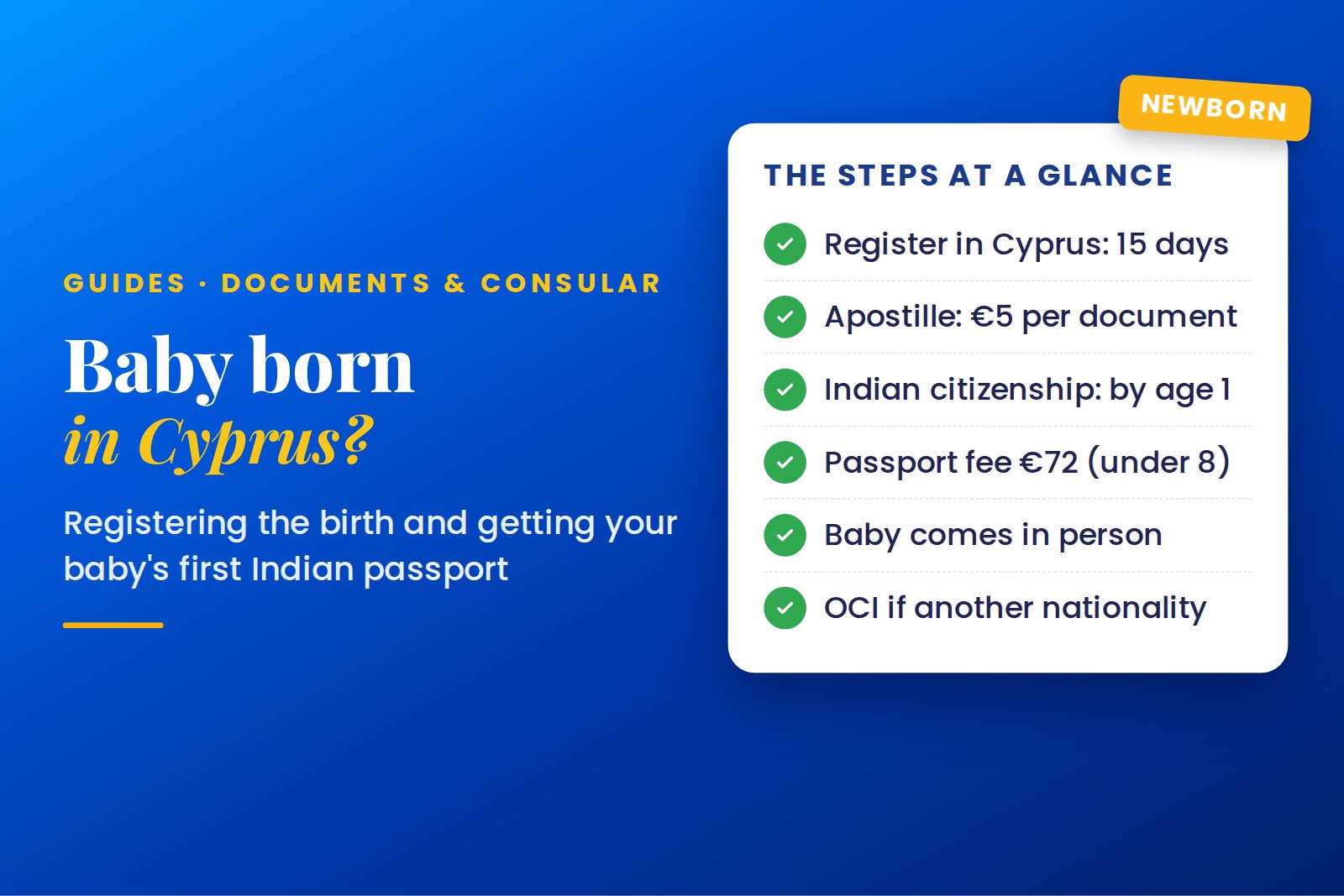
Step 1: Register the birth in Cyprus (within 15 days)
Cypriot law gives you just 15 days to record your baby's arrival, and that applies to foreign parents too. The doctor or midwife fills in the birth notification at the hospital, and you then take it to any District Administration Office, not necessarily the one where your baby was born.
- Bring both parents' passports, your residence permits (or ARC), and your marriage certificate if you're married.
- Ask for the certificate in English, and check that your baby's name and your names are spelled exactly as in your passports. A mismatch now causes trouble at every later step.
- Unmarried parents should check the rules on including the father's name before they go, as extra steps apply.
Step 2: Get the Apostille
Any Cypriot birth or marriage certificate you hand to the High Commission now needs an Apostille stamp, or your file comes back. It costs €5 per document at the Ministry of Justice's Apostille counters in Nicosia and Limassol. Do this before you start the Indian applications.
Step 3: Register your baby as an Indian citizen (within one year)
Indian citizenship doesn't pass to a baby born overseas on its own: you have to claim it. The High Commission's deadline is your baby's first birthday, and one parent must still be an Indian citizen when you apply. Don't let this slip.
- Apply online. Use the Ministry of Home Affairs' citizenship portal, where there's a specific form for children born abroad and registered through an Indian mission. Note the file number that appears when you submit.
- Print and sign. Print the submitted form; parents sign for the baby.
- Submit in Nicosia with: a copy of the Cypriot birth certificate (show the original), copies of both parents' Indian passports, an apostilled marriage certificate, an original affidavit stating that your child doesn't hold another country's passport, and a citizenship certificate if a parent became Indian by registration or naturalisation.
- The birth certificate from India. The Certificate for Registration of Birth itself is now requested through the E-Sewa portal. Wait for online approval before you visit the High Commission with your printout, copies, originals and the fee.
Step 4: Apply for your baby's Indian passport
With citizenship registered, you can apply for the passport. Fill in the application online through the Passport Seva portal for missions, print it, and gather:
- Three new photos of your baby: stick one on the form and clip the other two to it. Photos with the wrong specifications are refused, so use a studio that knows passport rules.
- Your baby's thumbprint in place of a signature: the left thumb for a boy, the right thumb for a girl.
- Your baby's Cypriot birth certificate (original plus a photocopy), and both parents' passports and residence permits, each with a copy you've signed.
- A consent letter from both parents. If one parent can't or won't consent, a separate declaration (Annexure G) applies.
Your baby must come with you to the High Commission. The fee for a first passport for a child up to eight years old is €72, and service takes around 4 to 6 weeks. The passport will last five years, or until your child turns 18 if that happens first.
If one parent isn't Indian
India doesn't allow dual citizenship. If your baby also gets the other parent's nationality, for example a Cypriot passport, your child generally can't hold an Indian passport as well. That's why the High Commission asks for an affidavit confirming the child has no other passport.
For these families, the answer is usually an OCI card. Children qualify if either parent is an Indian citizen. Apply on the OCI portal, pick Nicosia as your mission, and remember the Cypriot papers need Apostilles here too. Since 30 June 2026, OCI holders can also download a free electronic e-OCI card.
Note that being born in Cyprus does not, by itself, make a child Cypriot. Cypriot citizenship generally passes through a Cypriot parent.
What this means for you
- Use a simple timeline. Weeks 1–2: Cypriot birth registration. Next few weeks: Apostilles. Before the first birthday (ideally much sooner): Indian citizenship. Then the passport.
- Get the spelling right first time. Names must match across the Cypriot certificate, your passports and the Indian forms.
- Plan travel early. Your baby needs their own passport, or OCI card plus foreign passport, to fly to India. Allow at least two to three months for the whole process.
- Ask about your baby's Cyprus permit. Once your child has a passport, check with the Migration Department about a residence permit linked to yours.
- Ask when unsure. The consular section answers questions at cons.nicosia@mea.gov.in.
Read also: Apostille Now Mandatory for Key Consular Documents and OCI Cards From Cyprus: Who Can Apply, How, and When to Update
Sources: High Commission of India, Nicosia (birth registration), High Commission passport checklist, High Commission fee table, High Commission E-Sewa guidance, High Commission OCI overview, Cyprus Ministry of Interior, Caritas Cyprus, Cyprus Mail
Disclaimer: We make every effort to ensure the information in our guides is accurate and up to date, but rules, fees and procedures can change without notice. Please verify the details with the relevant official authority before acting on them. This guide is for general information only and is not legal, financial or immigration advice.
Related stories
Spotted an error? Tell us.